News

Field Day Findings: Insights from Four Family Farms

Join grazing and carbon specialists from Atlas Carbon to hear the journeys of four different NSW graziers currently in Soil Carbon Projects.

Leonie Marshall

Field Day Findings: Insights from Four Family Farms

This webinar unpacked what happens when strong grazing management becomes the engine of a high-integrity soil carbon project. Hosts Colin and Bart walked through the experiences of four family-run operations across very different landscapes - all using Atlas Carbon for project development and MaiaGrazing for planning and analytics.

Across every example, the core message was clear: grazing performance drives carbon outcomes. High-quality carbon credits emerge from day-to-day decisions that grow grass, protect ground cover and establish root systems.

Watch the Replay Now

Below is a streamlined summary of the key lessons shared during the session

What the Four Farms Had in Common

Even with different environments, soil types and enterprises, these producers were united by a practical approach: simplify management, enable recovery, and use grazing as the primary tool to build both productivity and soil health.

Coventry (Tamworth, NSW)

Enterprise: High-performance beef breeders, transitioning out of cropping
Focus: A simpler system anchored by a clear “grazing-first” framework
Key Moves:

  • Reduced graze periods from ~30 days to under 10 to enable plant recovery
  • Streamlined management to reduce noise and focus on grass fundamentals
    Impact:
    Boosted resilience, better ground cover, deeper rooting and more reliable feed across seasons.

The Ponds (Upper Bingara, NSW)

Enterprise: Aggregation of breeding, backgrounding and finishing
Focus: Improve plant nutrition and feed quality after stabilising grazing foundations
Key Moves:

  • Used high-density animal impact to move nutrients and distribute seed
  • Shifted the operation toward a long-term goal of permanent, productive pasture
    Impact:
    More consistent feed quality, improved nutrient cycling, and reduced reliance on forage cropping.

Grovedale (Trunkey Creek, NSW)

Enterprise: Sheep production
Focus: Better planning, clearer mob structure and disciplined recovery
Key Moves:

  • Simplified mobs and committed to structured, forward-looking grazing plans
  • Transitioned from set-stocking to recovery-driven grazing
    Impact:
    Deep root development in lighter soils, supported by multi-species pastures and improved grazing control.

Bokhara Plains (Brewarrina, NSW — Semi-Arid)

Enterprise: Landscape-scale grazing in a brittle environment
Focus: Radical simplification to regain control of grazing pressure
Key Moves:

  • Consolidated stock into 1–3 mobs across 200+ paddocks
  • Protected long recovery periods - often 300+ days
    Impact:
    The ability to harvest a full year’s growth in short windows, while seeing spontaneous recruitment of native grasses and saltbush without sowing.

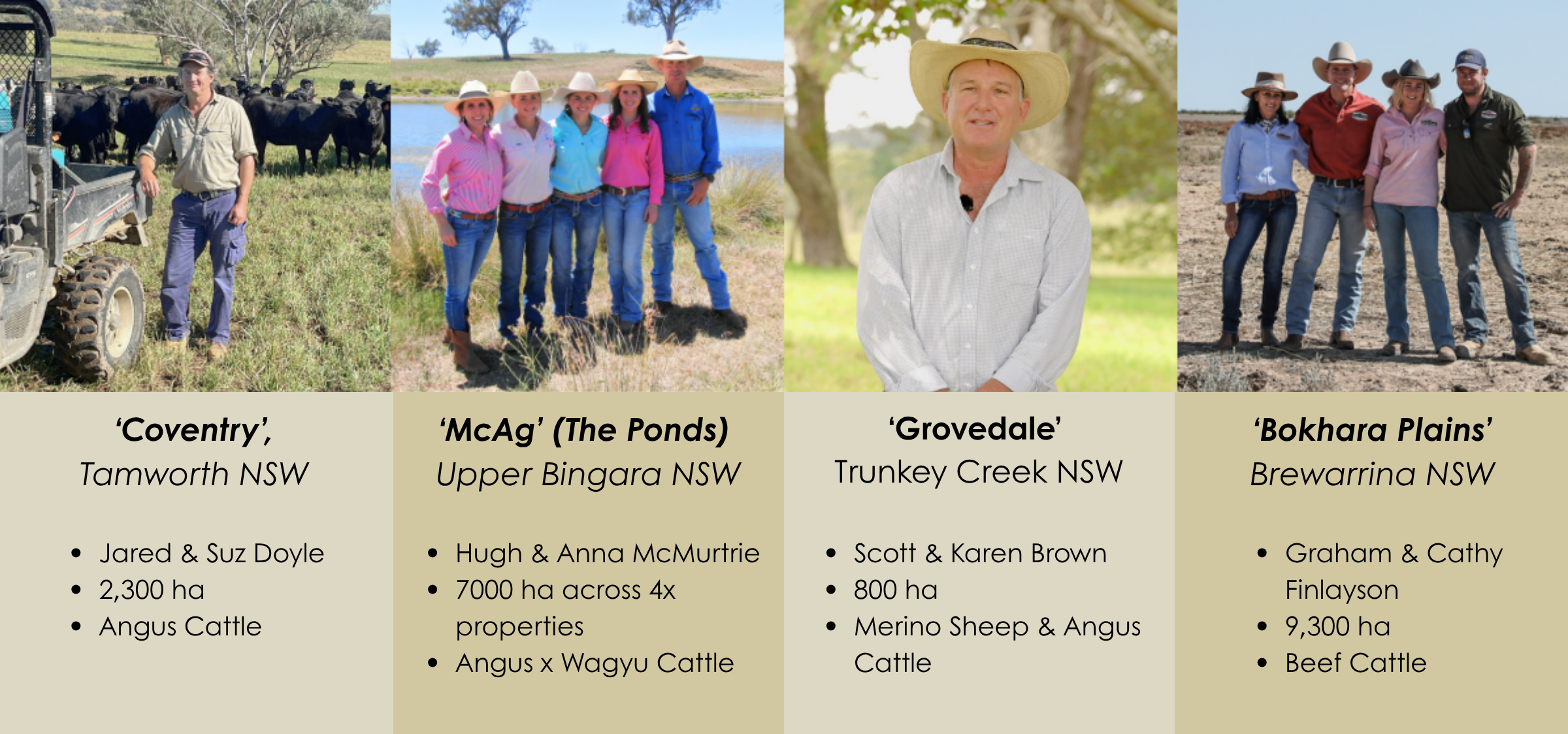
Property Snapshots

Four NSW Farms in Soil Carbon Projects
'Bokhara Plains' image: © Grow Love Project / Kylie Fisher (Land and Life Photography) / Soils for Life (2023)

What This Means for Soil Carbon Projects

A carbon project is an enterprise - not a side activity. And like any enterprise decision, it needs to stack up economically and make sense for the future of the land. The webinar closed with four practical considerations:

1. Treat Soil Carbon as a Business Unit

Run the numbers objectively. Understand the likely upside, the costs, and the operational changes required before committing.

2. Take a Long-Term View

A soil carbon project spans 25 years. Success depends on family alignment, a shared vision, and confidence in the grazing system underpinning it.

3. Focus on the Daily Drivers, Not the Lagging Indicator

Carbon accrual happens slowly. What matters day-to-day is managing grass, livestock, and root systems in ways that continuously lifts productivity and resilience.

4. Start with Due Diligence

Atlas Carbon helps producers assess whether their soils, scale and operating model are suitable. A high-level cost-benefit analysis often reveals if deeper investigation - including soil testing - is worth pursuing.


Want to join us in the paddocks at our next Field Day?

Enjoy a day on-farm at Hanaminno on the 10th of December with Atlas Carbon and Charlie Arnott, to see how soil-carbon projects and nature-based grazing are building healthier soils, stronger businesses and more resilient landscapes.

Register here

Get in touch with Atlas Carbon

Reach out to apply for a free Cost-Benefit Report to begin to understand your property’s potential. All you need to do is answer 15 questions about your property, and we’ll provide you a personalised estimate on revenues and costs for successful soil carbon project implementation. Estimates include carbon and production uplift potential, property input and infrastructure needs, and administration costs.